
Psychodrama: Body, Emotions and Skills
See the presentation:
If the player above doesn’t load, you can also open the presentation from the original link in the heading below.
Listen to podcast: How Psychodrama breaks Mental Loops: Brief examples of my training manual of psychodrama
Drama Therapy, Psychodrama : Healing Through Action
Psychodrama is a model of psychotherapy and social change based on Action. Instead of merely talking about problems, patients become «active agents» who represent their internal worlds through scenes, roles, and characters.
1. The Core Structure
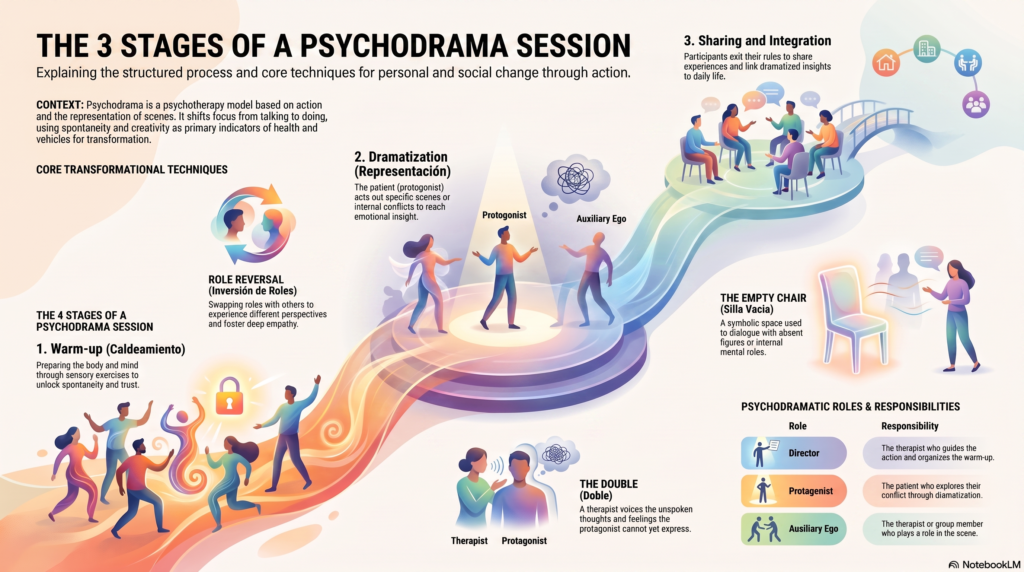
A session follows a specific sequence to ensure safety and therapeutic depth:
- The Stage: The physical or virtual space (office, classroom, or online) where the «as-if» reality is built.
- The Director: The therapist who proactively guides the session, proposes exercises, and manages the timing.
- Warming-up (Caldeamiento): This phase prepares the mind and body. It can be nonspecific (general sensory exercises like «dry showers») or specific (preparing for a particular scene).
- The Protagonist: The participant who explores their conflict or theme in the center of the action.
- Representation: The dramatization itself, where the conflict is materialized and explored in the «here and now».
- Sharing: After the action, participants share feelings and personal resonances, helping the protagonist feel accompanied rather than judged.
- Processing: A final reflection to analyze the dynamics and apply insights to real life
2. Essential Techniques
These tools allow the patient to externalize the unconscious and create a «supplementary reality» for healing:
- Role Reversal: The central technique where the protagonist exchanges places with another person to see the situation through their eyes.
- The Double: A support figure (the therapist or a peer) stands beside the patient, reproducing their posture and voicing «silent thoughts» that the patient might be afraid or unable to say.
- The Mirror: The protagonist steps out of the scene to watch an auxiliary represent them, allowing for a more objective «observing self».
- Soliloquy: A cinematic «voice-over» where the protagonist speaks their inner feelings aloud while freezing the action.
- Empty Chair: A tool for dialoguing with an absent figure or a specific internal part of the self.
3. The Philosophy of Health
In this «theater,» health is defined as spontaneity and creativity. By acting out rigid roles or traumas, the patient can find a «new response to an old situation,» transforming their internal theater into a space of freedom.
No responses yet